
Geogrids have become one of the most reliable tools for building stronger, longer‑lasting infrastructure on challenging soils. But while the category is often talked about as if all geogrids perform the same function, the reality is very different. Each type is engineered for a specific soil conditions and load requirement. Choosing the right one can dramatically reduce aggregate use, accelerate construction, and extend pavement life. On the other hand, choosing the wrong geogrid for the project can introduce unnecessary risk.
At Titan, our geogrid lineup is intentionally designed to address four distinct site challenges. Understanding these differences is the key to specifying the right solution.
Start With the Soil Beneath You
Every successful geogrid application begins with one question: What is your subgrade actually doing? Weak but dry soils behave very differently from saturated muskeg. Heavy industrial loads impose stresses that standard biaxial grids simply can’t handle. And in northern climates, freeze–thaw cycles can undermine even well‑designed structures if moisture isn’t managed.
Four of Titan’s geogrid families: Titan Earth Grid®, Swamp Grid®, Gladiator Grid®, and WickGrid™ each solve a different problem. Here’s how they differ and when each one matters most.
Titan Earth Grid®: Reinforcement for Weak, Dry Soils

Titan Earth Grid® is the classic biaxial geogrid engineered for mechanical reinforcement where soils lack bearing capacity but are minimally affected by moisture. Its uniform square apertures are sized for optimal interlock with granular material, while thick ribs and integral nodes provide the stiffness needed to distribute loads effectively. This makes it a dependable choice for forestry roads, rail ballast, foundation support, and access roads where the primary challenge is simply weak ground.
If your site is soft but dry and drainage isn’t a concern, Titan Earth Grid® delivers the stabilization needed to build with confidence.
Swamp Grid®: When Saturation Is the Real Enemy
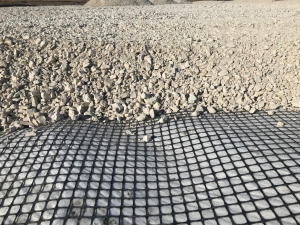
Some soils aren’t just weak. They’re wet, unstable, and prone to pumping and contamination. That’s where Swamp Grid® comes in. By bonding Titan Earth Grid® to a PET nonwoven geotextile, this composite system provides reinforcement, separation, filtration, and passive drainage in a single layer.
The geotextile prevents aggregate from disappearing into the subgrade, while its high flow rate helps relieve water pressure in saturated zones. This makes Swamp Grid® ideal for muskeg, peat, swampy road alignments, coastal corridors, and wet rail embankments where traditional reinforcement alone isn’t enough.
If your project sits on saturated ground, Swamp Grid® is the geogrid that keeps your structure from sinking.
Gladiator Grid®: High‑Stiffness Strength for Heavy Loads

Some projects demand more than standard reinforcement. Industrial yards, mining haul roads, working platforms, and highway construction all impose high, repetitive loads that require exceptional stiffness at low strain. Gladiator Grid® is engineered specifically for these conditions.
With radial stiffness values reaching up to 650 kN/m and beyond, Gladiator Grid® provides superior load transfer and confinement, reducing rutting and deformation under extreme traffic. Its optimized rib and junction design ensures that loads are distributed efficiently, even under complex multi‑directional stresses.
When your project involves heavy equipment, high traffic, or demanding load cycles, Gladiator Grid® is the high‑performance solution built to withstand it.
WickGrid™: Managing Moisture in Freeze–Thaw and Variable Conditions
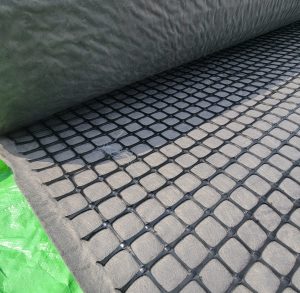
Moisture variability is one of the most overlooked causes of differential settlement. In northern climates or regions with inconsistent drainage, soils can shift dramatically as water moves (or fails to move) through the subgrade. WickGrid™ is engineered to solve this problem.
Its proprietary wicking geotextile actively transports water horizontally, equalizing moisture across the subgrade and preventing localized soft spots. This moisture homogenization is especially valuable in freeze–thaw environments, where uneven water content can lead to frost heave and long‑term structural issues.
If your site experiences fluctuating moisture or freeze–thaw cycles, WickGrid™ provides a level of control that standard geogrids simply can’t match.
Why These Differences Matter
The right geogrid can reduce aggregate thickness by up to half, accelerate construction timelines, and extend pavement life by two to three times. It can also reduce embodied carbon by minimizing excavation and limiting the need for virgin aggregate. But these benefits only materialize when the geogrid is matched correctly to the soil and loading conditions.
Dry weak soils, saturated subgrades, heavy industrial loads, and variable moisture each require a different engineering approach. Titan’s geogrid lineup is built around that reality.
Not Sure Which Geogrid You Need?
Titan’s technical team works directly with engineers and contractors to evaluate site conditions and recommend the right solution. From design assistance to installation support, we help ensure your project performs the way it should for decades to come.
Let’s build together. Request a consultation to discuss your site conditions and determine which Titan geogrid is the best fit for your project.