
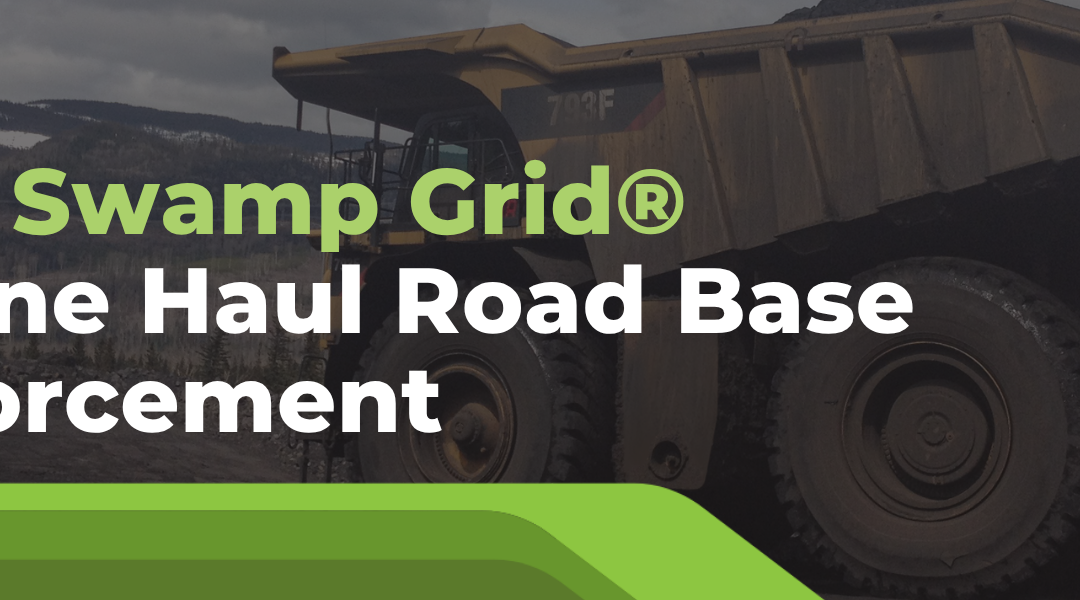
Mine haul roads are central to a mine’s productivity and safety. When roads are under‑designed, the consequences show up fast: increased maintenance, reduced haul efficiency, unsafe driving conditions, and rising costs on unnecessary aggregate. Traditional construction methods, simply adding more aggregate over a weak subgrade are no longer enough to meet the performance or sustainability expectations of modern mining operations.
Swamp Grid® offers a smarter, more efficient approach by reinforcing haul roads from the ground up.
Why Traditional Haul Roads Underperform
Conventional haul road construction relies on repeated aggregate placement and compaction to achieve stability. Over weak or saturated soils, this leads to rutting, pumping, differential settlement, and ongoing rehabilitation. The result is higher fuel use, more truck cycles, and avoidable downtime.
Under the heavy axle loads common in mining operations, weak subgrades deteriorate quickly, especially in regions exposed to seasonal saturation or freeze–thaw cycles. As roads degrade, operations face increased fuel consumption, more maintenance cycles, reduced equipment efficiency, and costly downtime.
Simply adding more aggregate is often an expensive short-term fix rather than a long-term solution.
A Composite Solution for Weak Subgrades
Swamp Grid® is engineered to stabilize soft ground and reduce aggregate demand. The composite geosynthetic combines a high‑strength biaxial geogrid with a continuous‑filament nonwoven geotextile through precision heat bonding.
This composite structure allows both components to work together as a single reinforcement layer:
- The biaxial geogrid provides reinforcement and aggregate confinement
- The nonwoven geotextile delivers separation, filtration, and drainage
Together, these functions improve load distribution, increase bearing capacity, and help maintain road integrity under heavy, repetitive haul traffic.
Designing for Harsh Conditions
In northern and remote regions, haul roads must withstand extreme temperature swings, saturated soils, and high ESAL loading. Installing Swamp Grid® at the base of the aggregate layer minimizes differential settlement, reduces lateral spreading, and extends the structural life of the road. Mines also benefit from reduced embodied carbon due to lower aggregate requirements.
Key Benefits of Swamp Grid®
- Reduced aggregate requirements
- Lower construction and maintenance costs
- Decreased excavation and backfilling
- Improved load distribution and road performance
- Enhance separation,drainage, and filtration
- Increase haul road service life
Managing Moisture in Water-Saturated Subgrades
Many mine sites face persistent water challenges: seasonal saturation, perched water tables, or poorly drained clay subgrades. In these environments, moisture variability becomes just as damaging as weak soils.
For these applications, WickGrid™ can be incorporated to help manage excess moisture within the subgrade. Its wicking geotextile actively transports water horizontally, helping equalize moisture conditions and reduce localized soft spots that contribute to rutting and differential settlement.
Key advantages include:
- Moisture equalization across saturated or variable subgrades
- Improved stability in areas prone to pumping or freeze–thaw
- Reduced maintenance by preventing water‑driven deformation
For haul roads built over water‑saturated soils, WickGrid™ complements Swamp Grid® by addressing the moisture‑related mechanisms that undermine long‑term performance.
Titan’s Technical Support Advantage
Titan backs every solution with engineering expertise and complimentary preliminary design support. Using advanced design software, our team provides application‑specific recommendations and installation guidance to ensure reliable performance in the field.
Contact us today to get started on your next project.