
When it comes to ground stabilization, separation, and reinforcement, the choice between geotextiles and geogrids can significantly impact project performance and cost. Yet, misconceptions still cloud the decision-making process.
Whether you’re designing a roadway over soft soils or reinforcing a containment system, understanding the distinct roles and advantages of these materials is essential. At Titan, we’re here to cut through the noise with practical insights and technical clarity—so you can specify with confidence and build with certainty.
Geotextiles and Geogrids: What’s the Difference?
Both geotextiles and geogrids are indispensable, but they serve different purposes.
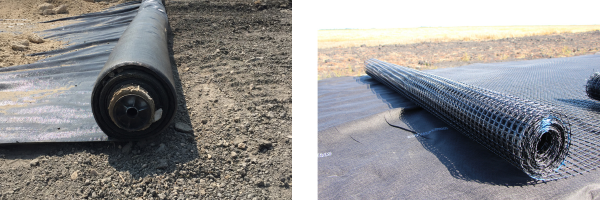
Geotextiles are permeable fabrics used primarily for separation, filtration, reinforcement, and drainage. They come in woven and nonwoven compositions, each with its own benefits and weaknesses.
Geogrids are grid-like geosynthetic materials engineered primarily for soil reinforcement and load distribution, offering high tensile strength, flexural stiffness, and minimal elongation. They work by interlocking granular material, strengthening and stiffening granular layers.
Woven vs. Nonwoven Geotextiles
 Woven Geotextiles are known for their high tensile strength and lower elongation, making them great for separation and reinforcement. However, they are prone to tearing when used with angular aggregates and may exhibit low permeability. They are commonly used in roadways and retaining wall support where strength and separation are critical.
Nonwoven Geotextiles offer excellent filtration, drainage, and cushioning. With high elongation properties, they’re commonly used in lining systems and protection layers. They are especially suited for drainage systems and landfill liners where filtration and protection are key.
Choosing the right type depends on your project’s specific needs—whether it’s strength, filtration, or drainage.
Debunking Common Myths
Myth 1: Geogrid composites are more expensive than high-strength geotextiles.
Fact:. When factoring in faster installation, reduced aggregate needs, and long-term durability, geogrid composites deliver superior value—even in regions with high-quality sub-base materials.
Myth 2: Typical values on data sheets are sufficient.
Fact: Always look for Minimum Average Roll Values (MARV)—the industry standard for reliable design performance as per ASTM D 4759. If MARVs aren’t listed, ask your supplier why.
Myth 3: Geotextiles and geogrids offer similar performance
Fact: While both materials are used in ground stabilization and reinforcement, their performance characteristics differ significantly. Geogrids provide immediate load distribution and confinement due to their rigid structure, making them ideal for reinforcement. Geotextiles, on the other hand, may stretch under load before engaging, which can delay reinforcement benefits.
Design Considerations for Engineers
When specifying geosynthetics, consider:
- Subgrade strength (CBR, undrained shear)
- Aggregate type and gradation
- Drainage and filtration needs
- Tensile strength, especially at lower strains
- Environmental exposure (freeze-thaw and UV resistance)
- Supplier support and technical expertise
Benefits & Use Cases: When to Use What
Use Geotextiles When:
- You need filtration or drainage (e.g., behind retaining walls, under riprap)
- Separation is required between dissimilar materials (e.g., subgrade and aggregate)
- Cushioning or additional protection is needed for geomembranes
Use Geogrids When:
- Reinforcement is the primary goal (e.g., base stabilization, embankments)
- You need to distribute loads and reduce rutting
- Working with weak subgrades or soft soils
Let’s Work Together
Titan’s technical team is here to help you navigate design considerations with precision. Whether you’re weighing geogrids vs. geotextiles or need site-specific recommendations, we’ll work with you to ensure optimal performance and value.
Contact us today for expert support, product guidance, and engineering insights that help you build smarter from the ground up.