

Consider a construction site where the task at hand involves stabilizing a steep slope or reinforcing a road foundation. The outcome of such projects depends significantly on the selection of appropriate materials. This is where geogrids become an essential component. However, with various types available, determining the most suitable option for your specific project can present a challenge.
Continue reading to understand the differences between uniaxial and biaxial geogrids, and to help you make an informed decision for your project.
What Are Geogrids?

Geogrids are geosynthetic materials used to reinforce soil and improve its load-bearing capacity. They work by interlocking with soil particles, creating a composite layer with improved mechanical properties. This interlocking action helps distribute loads more evenly, reducing the risk of soil movement and increasing the overall stability of the structure.
They come in two main types: uniaxial and biaxial. Each type has unique characteristics and is suited for different applications.
Uniaxial Vs Biaxial Geogrids
Uniaxial Geogrids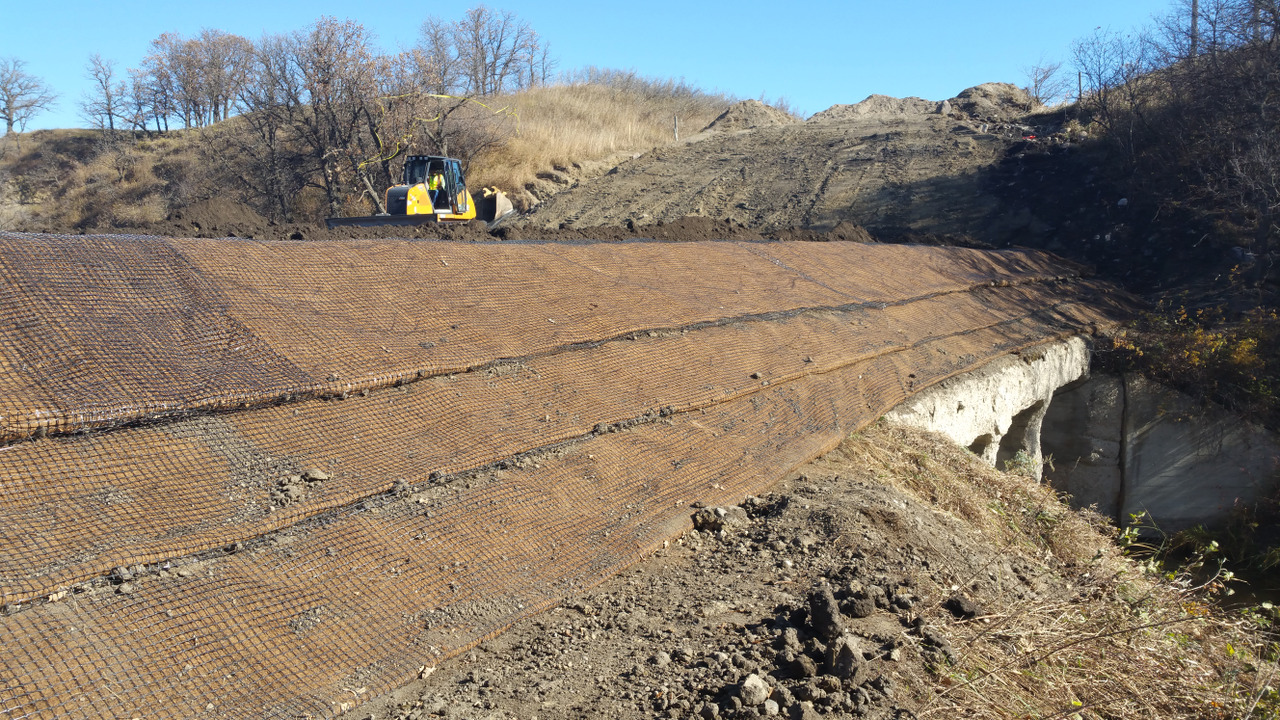
Uniaxial geogrids are designed to provide strength in one direction. They are characterized by their high tensile strength along the longitudinal axis, making them ideal for applications where the primary load is applied in a single direction.
For example, in the construction of a retaining wall, a uniaxial geogrid, such as Pyramid Grid™, provides vertical reinforcement, helping to hold back soil and prevent erosion. The geogrid is placed in layers within the soil, acting as necessary support to handle the pressure exerted by the retained soil. Its strength along a single axis allows for effective stabilization of the vertical structure, ensuring it remains intact and functional over time.
Uniaxial geogrids are commonly used in reinforced soil structures like retaining walls, steep slopes, and embankments, where the load distribution occurs mainly in one direction. Their ability to provide significant tensile strength in a single axis helps to resist the outward forces of the retained material, making them highly effective in projects where vertical support is critical.
Biaxial Geogrids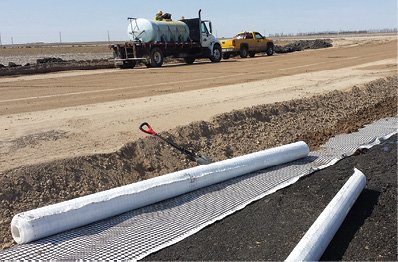
On the other hand, biaxial geogrids are designed to provide strength in both the longitudinal and transverse directions. This multidirectional strength makes a biaxial geogrid more suitable for a wider range of applications where loads are distributed across multiple directions.
Biaxial geogrids are typically used in subgrade stabilization and pavement reinforcement. Their flexibility and strength in both axes make them ideal for distributing loads more evenly across the surface, providing support in situations where the soil or foundation is subject to multidirectional stresses. For example, when constructing roadways or airfields, biaxial geogrids can improve the load-bearing capacity of the subgrade, preventing settling and cracking over time.
In road construction, a biaxial geogrid, like Spartan Road Grid™, is placed beneath the road surface to improve the durability of pavement by evenly distributing the weight of traffic and dispersing cracks, extending the lifespan of the road and reducing maintenance costs.
Another example is in the construction of landfill bases. Here, a biaxial geogrid is used to provide stability and reduce differential settlement. It is laid out at the landfill base, ensuring that the weight of the waste is evenly distributed and the structure remains stable over time.
When to Use Each Type
Opt for a uniaxial geogrid when reinforcement is needed in a single direction, such as retaining wall, slope, and embankment applications. Use a biaxial geogrid for applications requiring reinforcement in multiple directions, like roads, pavements, and landfill bases.
By understanding the differences between uniaxial and biaxial geogrids, you can select the right material for your project, ensuring proper structural stability and long-term performance. If you have any questions or need further assistance, feel free to reach out to us at Titan Environmental!
Let’s Work Together
To connect with us about a current or future project, simply give us a call or request a consultation with the concrete protection team using the form below.
If you already know your project requirements, click here to get a quote!
Our top priority is your project’s success.