
Civil and geotechnical engineers rely on geogrids to stabilize weak subgrades, reduce aggregate requirements, and extend pavement life. However, not all geogrids perform the same. Understanding the differences between traditional geogrids and next-generation solutions like Titan’s Gladiator Grid® is critical for designing systems that deliver reliable, long-term performance under real-world conditions.
Why Geogrids Matter in Modern Infrastructure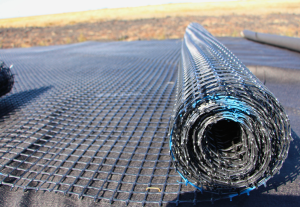
Geogrids play a pivotal role in soil reinforcement by interlocking with aggregate, distributing loads more efficiently, and stabilizing weak subgrades. This reinforcement mechanism is key to improving long-term pavement performance and reducing maintenance requirements and lifecycle costs.
Traditional approaches, such as unreinforced soil, aggregate-only sections, or steel reinforcement, often fall short due to insufficient tensile strength, susceptibility to corrosion, or limited service life. Geogrids, however, provide a more reliable and durable solution for modern infrastructure demands.
How Traditional Geogrids Perform
Traditional geogrids generally fall into two categories: uniaxial and biaxial. Each is designed to address different loading conditions:
- Uniaxial Geogrids: Provide high tensile strength in a single direction, making them ideal for retaining walls and steep slopes where forces act predominantly one way.
- Biaxial Geogrids: Distribute strength in two directions, making them a popular choice for road bases, parking lots, and rail applications. They provide a balance of stiffness and confinement under typical traffic loads.
Performance across all geogrid types depends on factors like rib geometry, junction strength, in-plane stiffness, and the ability to achieve effective aggregate interlock. While tensile strength often takes center stage in product data, it’s the combination of stiffness and interlock that truly determines how well a geogrid performs under real-world loading.
Enter Gladiator Grid®: A Next‑Generation Reinforcement System
Gladiator Grid® is engineered to address the performance limitations of traditional geogrids. It enhances aggregate interlock, confinement, and efficient load distribution — the three mechanisms that matter most for real‑world performance. Designed for real-world conditions, it delivers high stiffness at low strains—where pavement systems need it most to minimize deformation and maintain structural integrity.

Gladiator Grid® systems are designed with:
- High radial stiffness at low strain levels, allowing the system to resist deformation under construction loads and repeated traffic
- Optimized aperture geometry for superior aggregate interlock
- High‑strength ribs and junctions to maintain stiffness under compaction and traffic
- Engineered polymer blends for durability and long‑term creep resistance
- Consistent performance across variable soil conditions
Gladiator Grid® vs. Traditional Geogrids: Key Differences Engineers Should Know
1. Interlock & Confinement
Traditional geogrids vary widely in their ability to interlock with aggregate, even when aperture shapes appear similar. Gladiator Grid® is engineered to maximize particle engagement, improving confinement and reducing lateral movement under load.
2. Load Distribution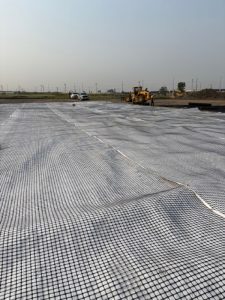
Multi‑directional stiffness is essential for pavements and heavy‑haul applications. While traditional biaxial grids offer balanced strength, Gladiator Grid® builds on this by delivering higher stiffness at low strains and optimized geometry to distribute loads more effectively.
3. Aggregate Reduction
By improving confinement and stiffness, advanced geogrids can reduce base and subbase thicknesses. This is a strong benefit widely documented in geogrid‑reinforced systems. Gladiator Grid® is designed to maximize these reductions, helping lower material usage, construction costs, and overall carbon footprint.
4. Performance Consistency
Traditional geogrids with similar published strengths often perform differently in the field due to differences in rib shape, junction integrity, and stiffness. Gladiator Grid® is engineered for consistent, predictable performance aligned with full‑scale trafficking research.
5. Installation Efficiency
Like other polymeric geogrids, Gladiator Grid® is lightweight, corrosion‑resistant, and easy to install. Its enhanced stiffness helps it maintain shape during placement, improving installation quality and minimizing wrinkles or deformation.
Where Gladiator Grid® Delivers the Most Value
 Gladiator Grid® is especially effective in conditions where subgrades are weak, highly plastic, or prone to excessive deformation. In these environments, its ability to enhance aggregate confinement and maintain stiffness under load helps create a more stable working platform and reduces the risk of early rutting or settlement. The system also performs well in heavy‑duty pavement structures, where a reinforcement layer is needed that can distribute stresses efficiently and maintain performance over time.
Industrial yards, unpaved haul roads, and other high‑traffic, high‑stress environments benefit from the grid’s ability to improve stability while reducing the amount of aggregate required. This material efficiency not only lowers construction costs but also supports projects aiming to reduce embodied carbon by minimizing the volume of quarried stone.
Gladiator Grid® is equally valuable on projects where designers are looking to optimize reinforcement without compromising constructability, long‑term durability, or installation efficiency—delivering a balanced solution across performance, cost, and environmental impact.
Ready to Strengthen Your Next Design?
If you’re evaluating reinforcement options or looking to improve performance on challenging subgrades, our team can help you determine whether Gladiator Grid® is the right fit. Titan provides design support, subgrade reviews, and project‑specific recommendations to ensure you get the most effective and economical solution for your site conditions.