
If you’re an engineer, designer, or project owner; you’ve likely felt the pressure: tighter sites, rising land costs, stricter environmental expectations, and the need to find an alternative solution faster than ever. Traditional retaining wall solutions can struggle to meet these demands. Mechanically Stabilized Earth (MSE) walls and slopes are purpose-built to do exactly that—offering a proven, flexible, and performance-driven approach to grade separation that meets today’s project realities.
Across North America, MSE systems are reshaping how we think about retaining structures. They’re solving problems that concrete walls struggle with and delivering measurable environmental benefits. Understanding how MSE structures work and why they’re being specified more than ever, can make a meaningful difference in your project’s success.
Solving Modern Grade Separation Challenges 
At their core, MSE structures are designed to address the kinds of site constraints that traditional concrete retaining walls struggle with. This includes costs, construction sequence and time, poor soil conditions, and improving sensitive environmental areas while reducing the carbon footprint. Unlike rigid concrete structures, MSE systems are flexible by design. They can accommodate greater levels of differential settlement, adapt to marginal ground conditions, and be shaped to suit curves and varying heights. This adaptability is one of the reasons they’ve become so widely specified across North America.
A Cost‑Effective Alternative to Concrete 
The appeal of MSE structures goes far beyond geometry. They are also one of the most cost‑effective retaining solutions available today. It is widely known and consistently shown that MSE structures can be 50 percent more economical than reinforced concrete alternatives. The savings come from multiple factors: faster installation, fewer specialized trades, lightweight components that can be placed by hand, less stringent QA/QC requirements and no forming and curing delays. For time‑sensitive projects, this speed is invaluable. Many MSE systems can be installed in half the time required for a comparable concrete wall. Thus helping contractors stay on schedule even when weather or site conditions are less than ideal.
To learn how these advantages can also support sustainability goals, check out our guide Cut Project Costs and Meet Sustainability Goals: Why Engineers Should Specify Vegetated MSE Walls.
The Rise of Vegetated MSE Systems
In recent years, vegetated MSE walls have been used more frequently as engineers look for ways to integrate sustainability into infrastructure without compromising performance. These systems combine the structural reliability of reinforced soil with the environmental benefits of living vegetation. The result is a retaining solution that not only holds back earth but actively contributes to stormwater management, erosion control, temperature regulation, biodiversity while lowering the carbon footprint of traditional concrete retaining walls.
Research from Southern Illinois University has shown that vegetated retaining walls can reduce stormwater discharge by as much as 85 to 90 percent compared to unplanted controls. Instead of shedding water rapidly, these systems slow, filter, and retain runoff. In turn, this helps reduce downstream flooding risks and improve water quality. The vegetation also plays a role in pollutant removal through natural biological processes.
Environmental Performance Beyond Stormwater 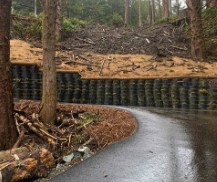
One of the most compelling real‑world examples of MSE performance comes from the ʔapsčiik t̓ašii project in Pacific Rim National Park. Faced with the challenge of protecting sensitive ecosystems while constructing a major trail corridor, the project team used flexible MSE systems to dramatically reduce environmental impact. The design approach lowered the number of trees removed from an estimated 25,000 to just 1,200. All while providing a stabilized MSE structure along the sides of a heavily traveled trail.
Choosing the Right MSE System
Not all MSE systems are the same. Titan’s solutions fall into two primary categories: Titan Earth Wall systems, which can be designed up to a 90‑degree batter, and Titan Earth Slope systems, which create steepened vegetated slopes up to 70 degrees. Both are engineered to meet project‑specific requirements, geometry and habitat integration while complying to the local design codes.
Building Resilient, Future‑Ready Infrastructure
As urbanization accelerates and sustainability becomes a defining requirement for public and private infrastructure, MSE walls and slopes offer a rare combination of structural performance, environmental benefit, and cost efficiency.
If you’re planning a project, Titan’s MSE technical team is ready to help you design with confidence and build with long‑term performance in mind.