
Question: When it comes to wastewater infrastructure, what is the best way to protect concrete pipe, chambers, lift stations, and digester tanks prone to corrosion?
Answer: Embedded High-Density Polyethylene (HDPE) or Embedded Polypropylene Concrete Protection Liners (CPL) are the superior protection technology for concrete wastewater infrastructure as it features anchors on the back of the liner that embed into the concrete. As the concrete cures around these anchors, the HDPE or Polypropylene liners become a permanent part of the pipe, riser section, or structure. In addition, the liners are chemically resistant to any standard municipal waste stream. The result is a liner that lasts the life of the structure with no ongoing replacement or maintenance costs.
An HDPE Concrete Protection Liner offers chemical resistance to standard wastewater streams, providing dual protection by safeguarding against Microbial-Induced Corrosion (MIC) caused by hydrogen sulfide and acid-producing bacteria, as well as preventing inflow and infiltration. Notably, it is the sole technology capable of delivering secondary containment in piping systems. Even if the primary gasket fails or the concrete experiences cracks, the system remains safeguarded against infiltration and inflow.
Question: How does embedded concrete protection liner (CPL) differ from spray-applied coating?
 Answer: Spray coatings only bond to the surface of the concrete, they do not embed into it. This makes them vulnerable to failure in the presence of backpressure. If a liner is going to fail, it is most likely to fail from back pressure, not something scraping the liner off the surface. Most spray coatings also require a fair amount of surface prep work, even on fresh concrete. Depending on the type of coating, sandblasting or hydro blasting on the existing surface is required per the manufacturer’s guidelines to properly prepare the surface for the spray liner to adhere to it. When applied, spray coatings have varied consistency and thickness. Samples can be taken to spot-check the thickness, but there is no way to check the coating’s thickness across the entire surface.
HDPE and Polypropylene concrete protection liners have anchors on one side. The concrete cures around those anchors, making them a structural part of the concrete. They can withstand back pressure up to 2 bar using the ASTM or German SKZ test methods for back pressure. In addition, all HDPE and Polypropylene liners are made in a controlled factory environment where the thickness, chemical, and physical properties are certified before leaving the manufacturing plant.
Question: Can embedded CPL be used to rehabilitate corroded manholes without trenching or digging?
Answer: Yes, the Titan Manhole Rehabilitation System incorporates embedded CPL technology and offers an innovative trenchless solution for the rehabilitation of corroded manholes and wet wells. There is no digging up of the manhole or structure and all work is completed underground without disruption to pavement, wetlands, or other surroundings.
The process begins by scanning the manhole and creating a digital 3-D model of the existing structure. The 3-D model is then used to create a custom homogenous base with inverts that are completely lined. After that, the 3-D image is used to create precise custom CPL vertical riser sections on a CNC machine. Each component is made specifically for the manhole or structure that was scanned.
All these components are then sent to the site and are grouted into place with a grout mix that exceeds 7,000 psi. The grout mix not only bonds the liner permanently in place but also migrates to fill in any cracks or voids in the original structure, adding integrity to the structure.
Spray liners cover the corrosion but offer no permanent rehabilitation of the structure and need to be replaced over time. Some other lined systems claim to be no-dig solutions, but installing them requires the removal of the ring and cover, cutting out surrounding pavement, and then digging up the cone of the manhole. This requires a new cone to be poured, soil compaction around the new cone, replacement of pavement, and replacement of the ring and cover.
The advantages of the Titan Manhole Rehabilitation System are: 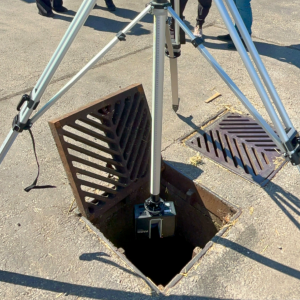
- The rehabilitation is a permanent rehabilitation preventing future corrosion.
- All components are custom-made for the manhole, wet well, or structure.
- No excavation is needed.
- No bypass is needed in most cases.
- All work is done underground with no disruption to the surroundings.
- Work can be done at night to minimize traffic or other disruptions.
Question: How does the Titan Manhole Rehabilitation System differ from other ‘no-dig’ manhole rehabilitation options?
Answer: The Titan Manhole Rehabilitation System stands out in various aspects when compared to other rehabilitation systems claiming to be ‘no-dig’ options. These options still involve digging up and replacing the ring, cover, and cone, whereas the Titan Manhole Rehabilitation System is a true trenchless option and minimizes roadway disturbance by avoiding such excavations. Additionally, unlike alternative options that attempt to line over the base or mechanically fasten fiberglass pieces, the Titan Manhole Rehabilitation System creates a one-piece solid base through 3D mapping, ensuring an exact fit with 100% embedment into the grout. Unlike other no-dig alternatives requiring complicated forms assembled on-site, the Titan Manhole Rehabilitation System simplifies the process. Furthermore, while other systems may use standard ready-mix concrete, the Titan Manhole Rehabilitation System employs high-strength, quick-curing grout, making it more efficient for small projects and enabling the rehabilitation of deeper manholes in a single day. The use of this system also prevents the loss of volume in the manhole due to thicker walls associated with standard concrete, providing a comprehensive and efficient solution for manhole rehabilitation.
Question: What makes CPL a superior material option for wastewater applications?
Answer: Yes, the Concrete Protection Liner (CPL) is specifically designed for wastewater management applications. Several features of CPL make it well-suited for this sector: 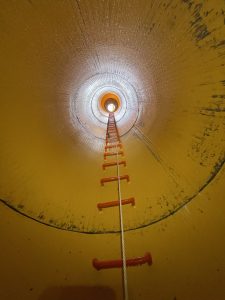
- Chemical Resistance: CPL is constructed from high-density polyethylene (HDPE) and polypropylene, providing it with a high degree of chemical resistance. In wastewater management, where exposure to various corrosive substances is common, this resistance is crucial to ensure the liner’s durability and longevity.
- Resilience: CPL exhibits high pull-out strength, making it capable of withstanding the mechanical stresses and pressures associated with wastewater systems. This strength is essential for maintaining the integrity of the liner in challenging operational conditions.
- Back Pressure: CPL embeds into concrete and becomes part of the structure, and therefore it can handle in excess of two-bar of back pressure when installed into the water table.
- Customization: CPL can be custom prefabricated to specific dimensions for pipes, wet wells, chambers, and poured-in-place structures. This flexibility allows for tailored solutions to fit the unique requirements of waste and wastewater management
- Abrasion: HDPE and poly provide excellent wear and abrasion resistance, superior to other lining methods. infrastructure, ensuring an optimal fit and performance.
In summary, HDPE and Polypropylene CPL products are the only products on the market designed to last the lifetime of the structure. Unlike most spray coatings, they embed into the concrete and do not need to be reapplied over time. This means they are a one-time investment with no future maintenance costs under normal operating
conditions.